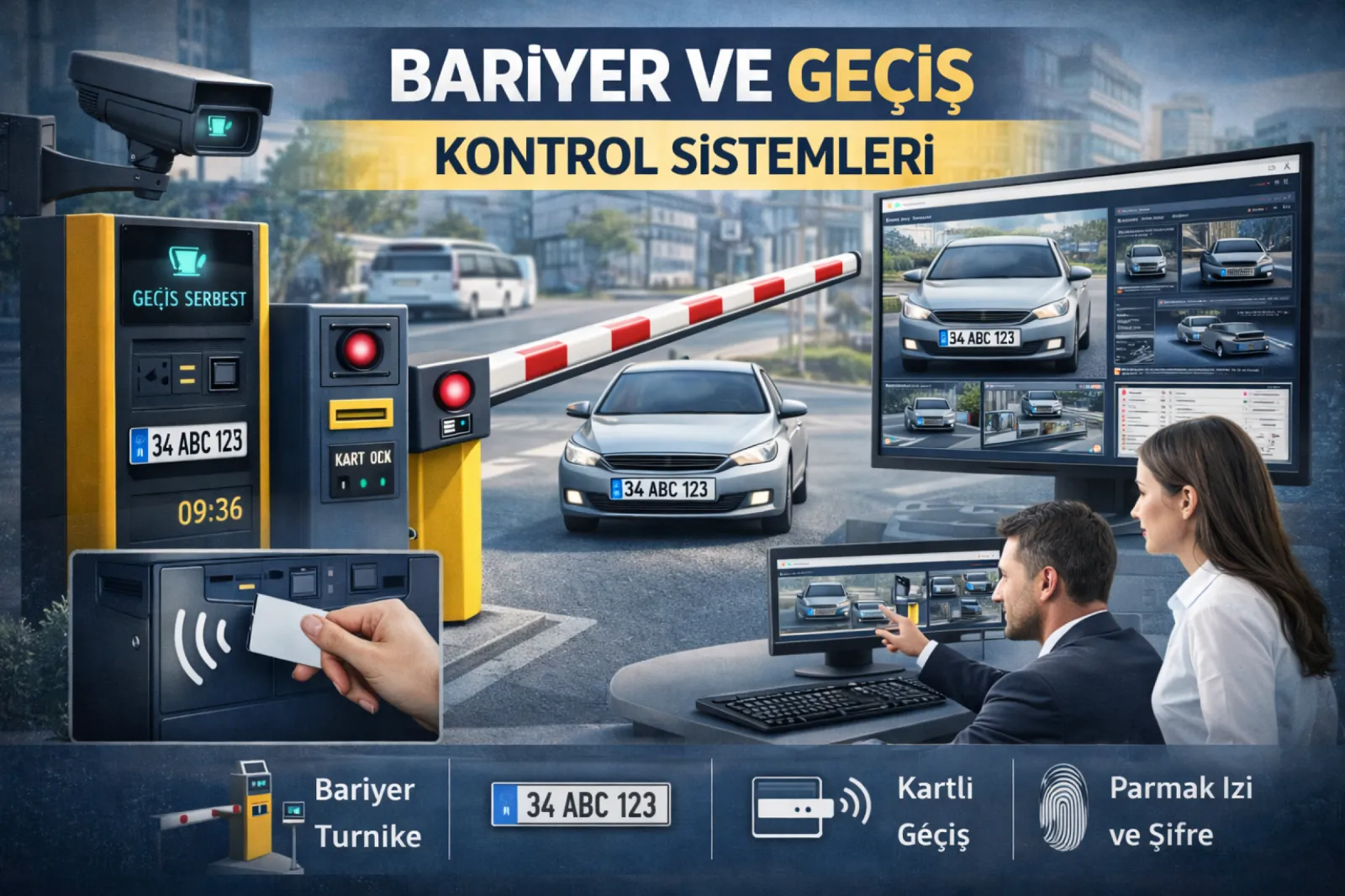
Barrier and Access Control Systems
In today's world, security, speed, and control are inseparable. Managing vehicle and pedestrian movement systematically in residential complexes, business centers, factories, and commercial facilities has become critical for both operational efficiency and security.
Barrier and Access Control Systems
Today, security, speed, and control can no longer be considered separately. Managing vehicle and pedestrian movement in an organized manner, especially at site entrances, business centers, factories, public institutions, parking lots, logistics areas, hotels, hospitals, and commercial facilities, has become critical for both operational efficiency and security. Barrier and access control systems are modern solutions that respond exactly to this need, making entries and exits planned, recorded, and authorized.
AOS Barrier and Access Control Solutions combine vehicle access barriers, license plate recognition systems, card access infrastructures, RFID-based automatic passage, turnstile systems, visitor control scenarios, and central reporting modules under one roof. In current industry solution pages, these systems are generally positioned alongside license plate recognition, parking automation, RFID passage, turnstiles, and high-security vehicle blocking systems.
What is a Barrier and Access Control System?
A barrier and access control system is a complete set of hardware and software that manages who, when, with what authority, and according to which scenario a vehicle or pedestrian enters an area. The main purpose of these systems is not just to create a physical obstacle. The real goal is to provide controlled passage, prevent unauthorized entry, regulate traffic flow, and record all movements. In industry descriptions, barrier systems are defined as basic components especially in controlled vehicle entry areas, while turnstiles are defined for pedestrian passages.
In other words, a modern access control system is not a simple mechanism that opens and closes a door; it is an intelligent management infrastructure that brings together functions such as identity verification, license plate verification, visitor management, time rules, capacity control, and reporting.
Why is a Barrier and Access Control System Needed?
In areas with heavy vehicle and human traffic, manual control processes can cause loss of time, security vulnerabilities, and lack of records. A barrier and access control system standardizes this process. It can be clearly tracked who entered, at what time, which vehicle the system recognized automatically, which card is authorized, or which visitor entered the area in which time interval.
Barrier solutions working integrated with license plate recognition, in particular, provide fast passage without human intervention in subscription parking lots, residential sites, and corporate facilities. Sectoral example pages clearly state that license plate recognition systems offer an automatic opening scenario for authorized vehicles by being integrated with barriers. In addition, some manufacturers and solution providers offer additional functions such as capacity management, LED information, and access control via multiple panels within the same structure.
How Do Barrier and Access Control Systems Work?
The system can work with different components depending on the scenario. The most common structure for vehicle entries consists of an automatic arm barrier, license plate recognition camera, RFID reader, card reader, loop detector, and software panel. When the vehicle arrives at the entry point, the system reads the plate or verifies the RFID/card information. When authority is confirmed, the barrier opens automatically, the event record is processed, and the passage time is archived.
For pedestrian passages, turnstiles, card readers, QR verification, biometric modules, or door control units come into play. Thus, only authorized personnel or visitors can pass into the relevant area. Companies producing controlled passage systems offer these structures together with vehicle barriers, turnstiles, under-vehicle imaging, road blockers, and different security equipment.
What Does an Automatic Barrier System Provide?
Fast and organized vehicle passage
It ensures that vehicles enter and exit the area in a controlled manner without the need for individual officer control. It reduces queues and shortens passage times, especially during peak hours.
Prevention of unauthorized entries
Passage can be blocked for license plates, cards, or tags not defined in the system. This significantly increases the security level.
Recorded movement management
Passages can be reported based on date, time, user, license plate, or entry method. Thus, past events can be reviewed retrospectively.
Reduction of operational costs
Personnel dependency decreases, manual recording burden drops, and incorrect entry decisions are minimized.
Corporate appearance and user experience
A modern barrier and access control infrastructure shows that the facility has a professional, controlled, and technology-oriented management approach.
Which Access Control Technologies are Used?
License plate recognition system
It automatically reads the vehicle plate and ensures the barrier opens for vehicles registered in the system. It is one of the most preferred solutions in areas such as parking lots, sites, plazas, factories, and terminals. In sectoral content, license plate recognition is presented not just as reading, but as a part of central management and automation.
RFID passage system
It offers fast, contactless, and practical passage thanks to the tag defined for the vehicle or user. It is especially suitable for subscription users who enter frequently. RFID solutions are one of the main headings in automatic passage system descriptions.
Card access system
It is widely used for controlled entries based on personnel, manager, visitor, or membership. It provides the advantage of card reading, time authorization, and generating user-based records.
Turnstile system
Used for pedestrian passage. Preferred in personnel entries, visitor areas, gyms, public buildings, and secure facilities. Barrier and turnstile systems are frequently positioned together in the industry.
Bollard and road blocker
Used in areas requiring higher security. Preferred in embassies, public buildings, critical facilities, and entry points with high security sensitivity. In the category of vehicle access control systems, bollards and road blocker products are shown among the standard options alongside arm barriers.
Where are Barrier and Access Control Systems Used?
Site and residence entrances
Provides fast entry opportunities special to residents with license plate recognition, remote control, card access, or RFID. Guest vehicles and visitor scenarios can be managed separately.
Business centers and plazas
Separate rules can be defined for personnel, managers, visitors, and parking lot users. Thus, both security and operation are managed from the same panel.
Factories and production facilities
Shipment, personnel, service vehicles, and supplier entries become controlled. Shift hours and vehicle-based authorization can be made.
Parking lots and paid parking areas
The barrier system can work together with license plate recognition, ticketing, payment points, and capacity management. This integration is one of the frequently used scenarios in the industry.
Hospitals, hotels, and campuses
Controlled, recorded, and flexible passage setups can be created in structures where different user types are in the same area.
Public institutions and critical security areas
A higher security level is provided with road blockers, bollards, turnstiles, and identity verification solutions.
The Power of Integration: Not Just a Barrier, but Intelligent Management
The element that makes the biggest difference in modern projects is not the barrier itself, but what it works integrated with. Because the current expectation is not just at the level of "vehicle came, arm lifted." Users now expect a structure where license plate recognition, card access, visitor registration, camera image, LED guidance, capacity management, and central reporting work together.
Indeed, many solution pages in the industry explain access control systems together with license plate recognition, parking guidance, full-empty systems, pricing, and central software infrastructures. In some examples, global capacity control over multiple panels and user information scenarios with LED signs are also included.
At this point, AOS offers not just a product, but a scenario-specific system design. Depending on the needs of the project, the following modules can be designed together:
- Automatic arm barrier system
- License plate recognition camera integration
- RFID or card access control
- Turnstile and pedestrian passage management
- LED screen and warning systems
- Parking full-empty and capacity management
- Central software panel and reporting
- Alarm, recording, and unauthorized entry scenarios
How to Choose the Right Barrier and Access Control System?
The right system selection cannot be made by looking only at the product price. The project's daily vehicle density, number of entries, security level, user type, field length, barrier arm length, integration need, and software expectation should be evaluated together. For example, while license plate recognition and remote management may be at the forefront for a residential site, road blockers and under-vehicle imaging may become more important in a critical security public area.
Therefore, for a successful project, these four elements should be handled together: field discovery, hardware quality, software flexibility, and service continuity. Manufacturer and integrator pages in the field of access control systems also show that the product range varies according to the application area, and vehicle and pedestrian control require different equipment.
Why Choose AOS Barrier and Access Control Solutions?
AOS handles barrier and access control systems not just as physical security equipment, but as digital infrastructures that speed up operations, clarify authority management, and increase recording discipline. Depending on the project, license plate recognition, card access, RFID, turnstiles, paid parking management, LED guidance, and central reporting can be brought together in the same system.
Thanks to this approach, customers do not just buy a barrier; they have a corporate access control infrastructure that works in the field, can be managed, scaled, and developed according to different needs.
Conclusion
Barrier and access control systems are modern facility management solutions that bring security, speed, order, and record management together at the same point. From site entrances to factories, from plazas to parking lots, from hospitals to public institutions, automatic, integrated, and reportable systems are now preferred instead of manual entry control. Industry examples also show that these solutions are positioned together with license plate recognition, RFID, turnstiles, capacity management, and central software.
AOS Barrier and Access Control Systems offer a new generation solution approach that can be adapted to different sectors, manage vehicle and pedestrian traffic together, and improve user experience while increasing security.
Related Products
Related References
For Detailed Info and Presentation
Our expert and technical team will contact you to prepare a detailed feasibility study.