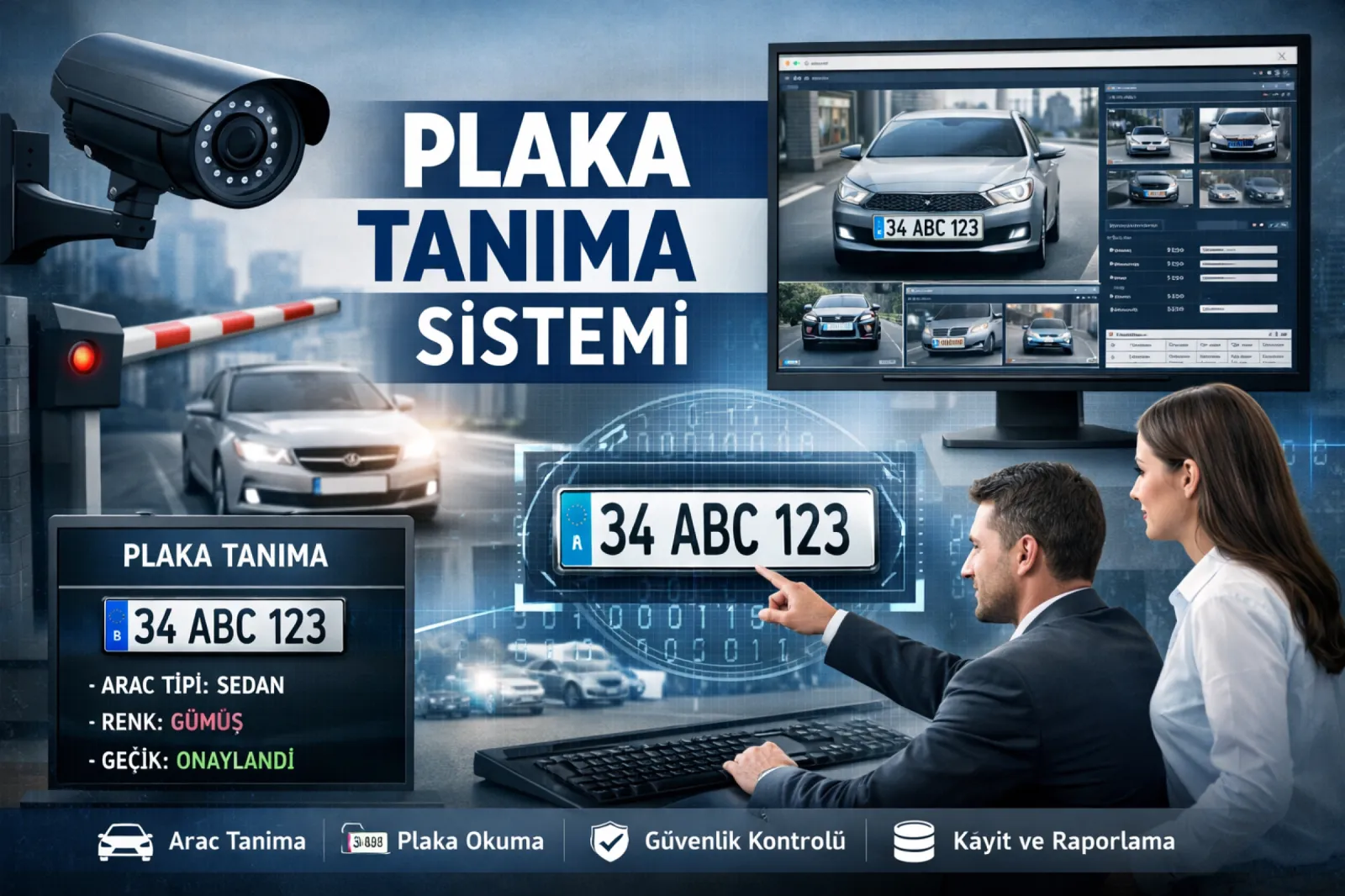
License Plate Recognition Systems
License Plate Recognition Systems are modern access control technologies that ensure the secure, fast, and recorded management of vehicle entries and exits. With new technologies, we are the first and only company to develop an AI-Based Computerless License Plate Recognition System.
Secure, Fast, and Smart Access Control with License Plate Recognition Systems
Used in various areas from residential parking lots to businesses, public institutions to shopping malls and bus terminals, these systems automatically detect, record, and authorize vehicle license plates. They manage barriers, gates, parking occupancy, reporting, and pricing processes according to specific scenarios.
License Plate Recognition (LPR) Systems are advanced access control solutions that automatically detect, record, authorize, and manage vehicle entries and exits. Today, these systems are used in many locations such as residential parking lots, commercial facilities, public institutions, paid parking areas, factories, and terminal areas, offering significant advantages in terms of security, speed, control, and operational efficiency. Especially in areas with heavy vehicle traffic, LPR systems reduce manual control processes, facilitating business management and improving the user experience.
A modern license plate recognition system is not limited to just reading vehicle plates. It also integrates with barrier systems, automatic gates, parking occupancy structures, central management software, subscription scenarios, visitor records, pricing infrastructures, and reporting modules to create an end-to-end vehicle access management system. This ensures that vehicle movements are controlled, authorized and unauthorized entries are differentiated, and business-specific scenarios can be easily implemented.
What is a License Plate Recognition System?
A license plate recognition system is an automation solution that automatically detects vehicle plate information using camera and software support and processes this data according to predefined rules. The system can read the plate of a vehicle approaching the entry or exit point within seconds, match it with the database, and initiate action based on authorization status. Barriers can be opened for authorized vehicles, visitor vehicles can be recorded, warnings can be generated for blacklisted vehicles, and stay duration and fee calculations can be performed in paid parking scenarios.
Thanks to this structure, vehicle passages are managed quickly and in a controlled manner without the need for manual intervention. Especially in areas with continuous vehicle circulation, license plate recognition systems provide significant advantages in terms of both security and time savings.
Where are License Plate Recognition Systems Used?
License plate recognition systems are among the technological solutions with a very wide range of applications. They can be projected according to different needs in various sectors.
In residential and residence parking lots, residents' vehicles can be automatically recognized; guest vehicles can be recorded, and security personnel can monitor all passages via a central screen. In paid parking lots, entry and exit times are automatically recorded to calculate the duration of stay, and pricing processes can be managed accordingly. In commercial areas such as factories, warehouses, business centers, and logistics facilities, the controlled entry and exit of personnel, visitors, suppliers, and service vehicles can be ensured.
In public institutions, municipalities, protocol areas, and facilities with high security sensitivity, it becomes possible to systematically manage authorized vehicle passages. In shopping malls, hotels, hospitals, and private enterprises, it creates a vehicle control infrastructure that both increases user satisfaction and raises the security level. In bus terminals and field operations with heavy vehicle traffic, license plate recognition systems are of great importance for record-keeping, ease of inspection, and central reporting.
How Does a License Plate Recognition System Work?
The working logic of a license plate recognition system is based on correct camera positioning, a powerful image processing infrastructure, and accurate software configuration. The LPR camera placed at the entry or exit point detects the vehicle and captures the plate image. The captured image is analyzed by the system to read the plate information. The read plate is compared with previously created vehicle records, subscription lists, authorization definitions, or paid parking rules.
Following this process, the system takes automatic action according to the scenario. A barrier can open when an authorized vehicle arrives. A record can be created for a visitor vehicle. An alert can be sent to the security screen when an unauthorized vehicle is detected. In paid parking use, the vehicle's entry time is recorded, and the duration-based fee can be automatically calculated at the moment of exit. All these processes occur instantaneously and are archived for reporting purposes.
Advantages of License Plate Recognition Systems
License plate recognition systems are not just a technology that provides entry-exit control; they are also a significant efficiency and security solution for businesses. One of the most important advantages of these systems is providing fast vehicle passage. Since processes such as remote controls, cards, or manual barrier opening are minimized, vehicle queues are reduced, and entry-exit processes become more fluid.
On the security side, recording vehicles based on their plates provides a great advantage. Information such as which vehicle entered when, how long it stayed inside, and from which point it entered or exited can be easily viewed through the system. Applications such as unauthorized vehicle detection, blacklist control, and special alarm scenarios are also possible.
License plate recognition systems also reduce human error. Automating processes such as manual vehicle registration, visitor tracking, or barrier control lowers the operational error rate. The ability to receive detailed reports with central software support provides analysis and control advantages to business management. These reports are highly valuable, especially for site managements, parking lot operators, factories, and corporate facilities.
In addition, many different advantages such as subscription scenarios, guest vehicle tracking, personnel vehicle control, time-based passage rules, paid parking tariffs, and the ability to manage multiple points from a single center are among the reasons why license plate recognition systems are preferred.
Our License Plate Recognition System Solutions
Every facility's needs are different. Therefore, instead of a one-size-fits-all product approach in license plate recognition systems, it is of great importance to develop solutions specific to the field and usage scenario. Before starting a project, we plan the most accurate infrastructure by evaluating the physical structure of the area, vehicle density, entry-exit scenarios, lighting conditions, security needs, and integration expectations.
In license plate recognition systems prepared for residential and residence projects, residents' vehicles, management vehicles, duty personnel, and guest passages can be defined with different authorization levels. This ensures both security and accelerates the user experience. In computerless license plate recognition solutions, more practical and economical structures working with embedded architecture can be established. This solution provides a great advantage, especially in areas needing more compact and simple systems.
In paid parking projects, the license plate recognition system provides professional automation by bringing together vehicle entry and exit records with the fee calculation infrastructure. The system can be made much more comprehensive with modules such as barrier integration, payment points, attendant screens, occupancy management, and central reporting. Furthermore, for commercial facilities, factories, logistics areas, corporate parking lots, and private security zones, fully controlled passage infrastructures can be established by developing needs-oriented LPR projects.
Why Should a Professional License Plate Recognition System Be Preferred?
Success in license plate recognition systems does not only depend on the camera or software screen used. The correct operation of the system in the field depends on making an accurate discovery, determining the appropriate camera angle, selecting hardware suitable for day and night conditions, and establishing compatible integration with barriers and other systems. Solutions that look strong on paper but do not work stably in the field can create costs and dissatisfaction for the business over time.
Therefore, when choosing a professional license plate recognition system, a holistic solution approach should be evaluated rather than just the product. Correct projecting, technical consultancy, software compatibility, field installation, testing process, user training, and technical service support directly affect the long-lasting and efficient operation of the system.
We treat license plate recognition systems not just as a sales item, but as a professional infrastructure that will contribute to the daily operation of the business, truly work in the field, and grow according to needs. Thanks to this approach, we offer our customers a working solution, not just a product.
What to Consider When Choosing a License Plate Recognition System?
For a correct license plate recognition system investment, some basic criteria must be carefully evaluated. First, the physical structure of the area and the location of entry-exit points should be analyzed. Camera placement, vehicle approach angle, lighting conditions, and vehicle density directly affect system performance. It is important to offer stable plate reading success under different light conditions during the day and night.
In addition, the system must be able to work integrated with other components such as barriers, gates, LED screens, occupancy systems, payment systems, or central management software. Supporting scenarios such as subscriber vehicles, guest vehicles, visitors, blacklists, personnel vehicles, and different passage times also provides a great advantage. A strong reporting infrastructure, the ability to easily examine past records, and the possibility of future capacity expansion are also important factors to consider.
Frequently Asked Questions
To the simplest question of what a license plate recognition system is, it can be said that it is an access control system that automatically reads and manages vehicle plates. The answer to how a license plate recognition system works is that the camera images the vehicle plate, the software reads the plate, compares it with the database, and generates action according to the scenario.
The answer to whether a license plate recognition system is suitable for a residential parking lot is clear: Yes, it is very suitable. Because it automatically recognizes residents' vehicles, organizes guest passages, and increases security. The answer to what a license plate recognition system does in paid parking lots is that it records entry-exit times, calculates the parking usage duration, and automates pricing processes.
The question of whether barriers and license plate recognition systems work together is also frequently asked. Yes, LPR systems can work integrated with barrier automation. When an authorized vehicle arrives, the barrier opens automatically; passage can be blocked for unauthorized vehicles. To the question of what a computerless license plate recognition system is, it can be answered as a compact plate reading solution that works in an embedded structure, reducing the need for an external computer.
License Plate Recognition Systems are one of the most effective solutions for today's modern vehicle access control needs. Bringing together security, speed, recording, reporting, automation, and user comfort in the same structure, these systems have a wide range of use from residential sites to commercial facilities, public institutions to paid parking lots. A correctly projected LPR system not only controls passages but also raises the overall operational quality of the business.
If you want to make your vehicle passages more secure, fast, and professional, and establish the right license plate recognition infrastructure for your residential parking lot, paid parking lot, corporate facility, or special project areas, we can plan the solution specific to your needs together. We offer end-to-end solutions in license plate recognition systems with the right product selection for the field, strong software infrastructure, professional integration, and sustainable technical support.
Contact us to get detailed information about License Plate Recognition Systems, request a project-specific quote, and make a discovery request.
Related Products
Related References
For Detailed Info and Presentation
Our expert and technical team will contact you to prepare a detailed feasibility study.