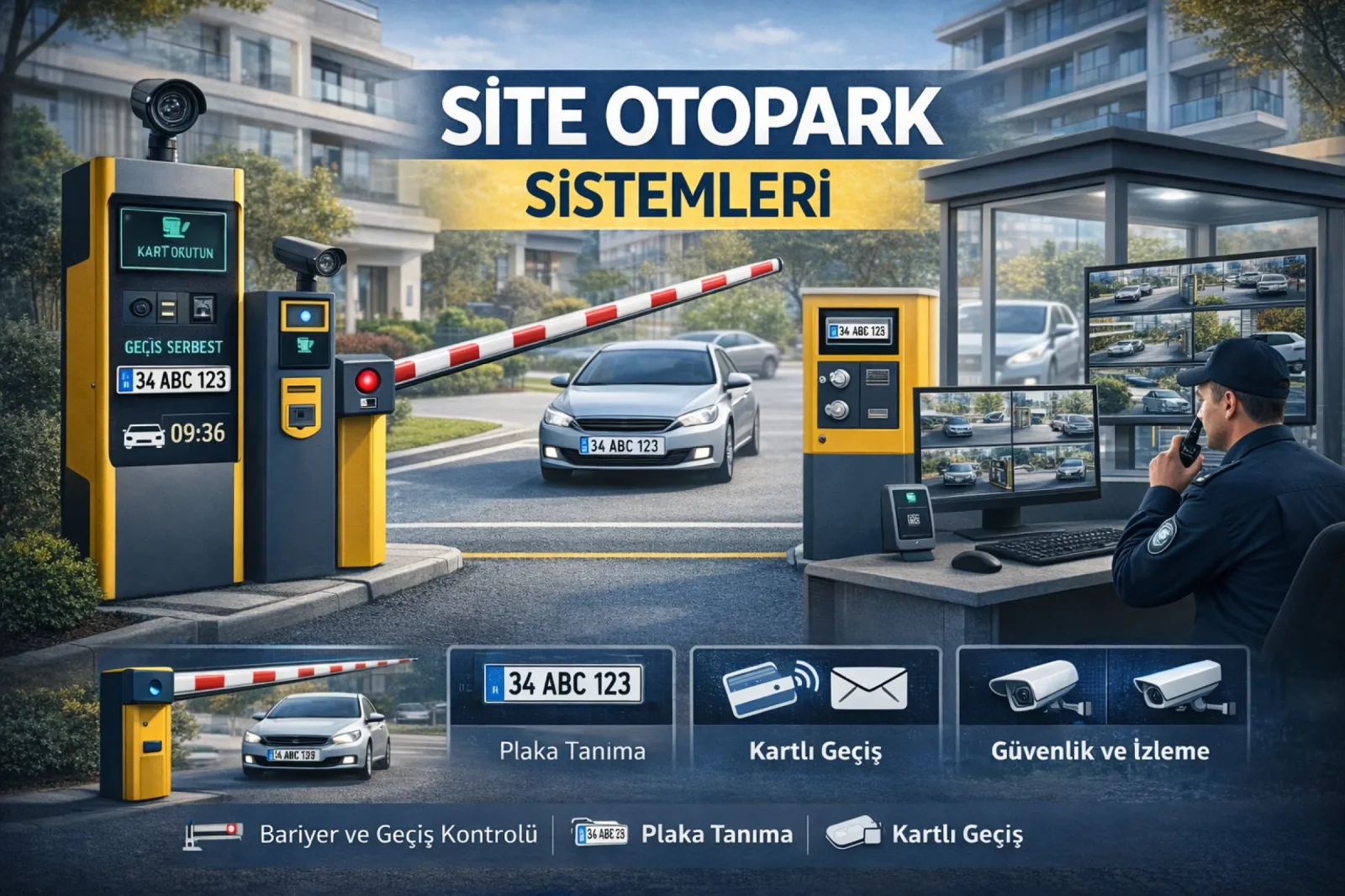
Residential Parking Management
Residential parking systems are professional access control solutions used in apartments, housing complexes, residences, and villa projects to organize vehicle entry-exit flow, prevent unauthorized access, facilitate parking for residents, and enhance security.
Residential Parking System Solutions
Residential parking systems are professional access control solutions used in apartments, housing complexes, residences, and villa projects to organize vehicle entry-exit flow, prevent unauthorized access, facilitate parking for residents, and enhance security. In modern residential projects, simply using a barrier is no longer sufficient; license plate recognition, remote authorization, guest vehicle management, subscription logic, block-based authorization, and recorded vehicle movements must be considered together.
A correctly configured parking system for site management reduces the burden on security personnel, decreases vehicle queues, provides fast passage for residents, and allows for the controlled entry of visitor vehicles. Additionally, information such as which vehicle entered when, which gate was used, and which block or independent unit it is associated with can be monitored centrally. This transforms the residential parking lot from just a parking area into a manageable and auditable security layer.
What is a Residential Parking System?
A residential parking system is an automation infrastructure that controls vehicle entry and exit in housing projects, recognizes authorized vehicles, manages guest vehicles, and operates with components such as barriers, license plate recognition cameras, remote opening, RFID, HGS, or mobile authorization. While often summarized as "automatic barrier opening for subscribed vehicles" on competitor pages, the field requirements go beyond this. Especially in multi-block sites, needs such as unit-based authorization, multiple vehicle rights, guest limits, tenant-owner distinction, and log history become critical.
These systems can be installed scalably, from small apartments with a single entrance to large site projects with multiple gates. Correct system design should be done by considering the field structure, vehicle circulation, resident profile, and security procedures, not just device selection.
Why are Residential Parking Systems Necessary?
In traditional structures, residential parking often relies on manual control by security guards, remote controls, or a limited number of card passes. This structure creates various problems over time: remote control sharing, lost remotes, unauthorized vehicle entries, uncontrolled use of guest vehicles, waiting at exits, lack of control during night shifts, and the inability to maintain healthy historical records.
A professional residential parking solution systematically reduces these problems. Authorized vehicles are automatically recognized, visitor vehicles are recorded under control, entry-exit records are archived, and site management can audit the entire process more transparently. While most competitor pages emphasize "easy entry" and "automatic barriers," the real value that improves user experience is the combination of security, speed, auditability, and ease of management.
How Does a Residential Parking System Work?
The residential parking system works by detecting the vehicle at the entry point. Depending on the technology used, a license plate recognition camera, RFID tag, card reader, remote control, or mobile approval mechanism is activated. The system checks whether the incoming vehicle is authorized. If it is an authorized vehicle, the barrier opens automatically; if not, security approval, visitor registration, or alternative entry scenarios are applied.
Authorized Vehicle Recognition
Vehicles belonging to residents, management, or specific blocks are defined in the system. The vehicle plate is recognized at the entry point, and if a match is found, the barrier opens automatically. This structure provides great convenience, especially during peak entry hours.
Guest Vehicle Management
Visitor identification can be made for guest vehicles. Visitor records can be created via security personnel, the management panel, or mobile approval logic. Thus, the vehicles allowed inside are kept under control, and historical records can be accessed when necessary.
Entry-Exit Records
For every vehicle entering the system, the time, date, gate information, and passage status are recorded. These records provide significant advantages for security investigations, site management reports, and potential dispute processes.
Barrier and Access Control
When vehicle verification is complete, the barrier opens. In some projects, entry and exit are managed separately, while in others, a common gate is used. In large sites, different passage scenarios can be created for each block or parking island.
License Plate Recognition (LPR) Residential Parking System
LPR residential parking systems are one of the most preferred solutions in housing projects today. This model also stands out on competitor pages; automatic opening for subscribed vehicles and software-managed entry-exit control are presented as core advantages. However, a good residential LPR system is not just a structure that reads the plate and opens the barrier; it is a solution that manages authorization, recording, security, and site operations together.
Advantages of LPR for Residential Projects
- Reduces the need to carry remote controls
- Automatically recognizes authorized vehicles
- Shortens entry and exit times
- Records passage history
- Reduces the manual workload of security personnel
- Provides centralized management for multiple entry gates
- Allows managing tenant, owner, management, and guest vehicles with different rules
Especially in sites with high vehicle density, LPR significantly increases both user satisfaction and security discipline.
In Which Projects are Residential Parking Systems Used?
Residential parking systems can be used in many structures, from small-scale apartments to villa sites, public housing areas to mixed-use projects, not just in large residences.
Common Application Areas
- Apartment parking lots
- Public housing complexes
- Residence projects
- Villa sites
- Mixed-use projects
- Managed open and closed parking areas
- Private campuses used by staff and residents together
While a simple barrier and LPR structure may be sufficient for small projects, multi-gate architecture, security booth integration, block-based authorization, and visitor flow should be planned in more detail for large projects.
Advantages of Residential Parking Systems
The biggest gain for site management is the organization of uncontrolled vehicle flow. However, the advantages are not limited to this.
Security Advantage
It makes it difficult for unauthorized vehicles to enter. Since every vehicle's entry time is recorded, security auditing becomes stronger.
Fast Passage and User Comfort
Residents can enter quickly without having to look for remotes, inform security, or wait at the gate. This makes a big difference, especially during morning and evening rushes.
Guest Control
Visitor vehicles are taken inside in a recorded and controlled manner, not randomly. This is important for both security and management transparency.
Centralized Management and Reporting
Site management can track vehicle lists, passage records, authorization definitions, and gate movements from a single screen. This feature provides a serious operational advantage in multi-gate structures.
Flexible Authorization
Vehicle limits per unit, tenant-owner distinction, temporary authorization, service vehicle authorization, or special definitions for management vehicles can be made.
Components Used in Residential Parking Systems
Requirements for a parking system where users can enter and exit comfortably include:
Main System Components
- License plate recognition camera
- Barrier system
- Access control software
- Central management panel
- Security booth integration
- Remote opening or mobile authorization infrastructure
- RFID, card, or tag options
- LED information display
- Network infrastructure and recording server
Not every project may need all components. Correct engineering starts with configuring the system suitable for the need without creating unnecessary costs.
Management Panel and Reporting Features
In residential parking systems, the management panel is at least as important as the field hardware. Because the real value for site management is making the processes visible and manageable, rather than just opening the barrier.
What Should be in the Management Panel?
- Defined vehicle list
- Unit or block-based matching
- Guest vehicle records
- Entry-exit times
- Gate-based movement history
- Temporary authorization and cancellation processes
- Blacklist or blocked vehicle definition
- Density and usage analysis
- Operator transaction logs
This structure makes it easier for the management office and the security team to work on the same data.
How to Choose the Right Residential Parking System?
The right system choice should not be made based on product price alone. The vehicle density of the housing project, the number of entries, open or closed area structure, the number of security personnel, visitor traffic, and the possibility of future expansion should be considered.
Things to Consider When Choosing
- Daily vehicle entry-exit density
- Whether it is a single gate or multiple gates
- Open area or indoor parking structure
- Number of resident, tenant, and guest vehicles
- Security personnel workflow
- LPR accuracy and night performance
- User-friendliness of the software
- Strength of reporting and recording infrastructure
- Technical service and maintenance continuity
- Suitability for adding new blocks or gates in the future
A good system is one that does not tire the management over months and years, not just one that works on the day it is installed.
Why Our Residential Parking Systems Solution?
We do not see residential parking systems as just a barrier installation. In every project, we evaluate vehicle traffic, the number of gates, resident profile, security operation, and management expectations together. Thus, we configure the right solution that is not unnecessarily complex for apartments and will not be insufficient for large sites.
Thanks to our solution approach:
- Residents get fast and comfortable passage
- The security team works more controlled
- Unauthorized vehicle entries are reduced
- Visitor flow becomes recorded
- All processes can be monitored via the management panel
- Central control is provided in multi-entry projects
- The system can adapt to growing projects
Residential parking systems are an important infrastructure that provides security, speed, order, and user comfort together in modern housing projects. When components such as LPR, barrier control, visitor management, and centralized reporting come together correctly, the residential parking lot becomes more controlled, safer, and more efficient.
Related Products
Related References
For Detailed Info and Presentation
Our expert and technical team will contact you to prepare a detailed feasibility study.