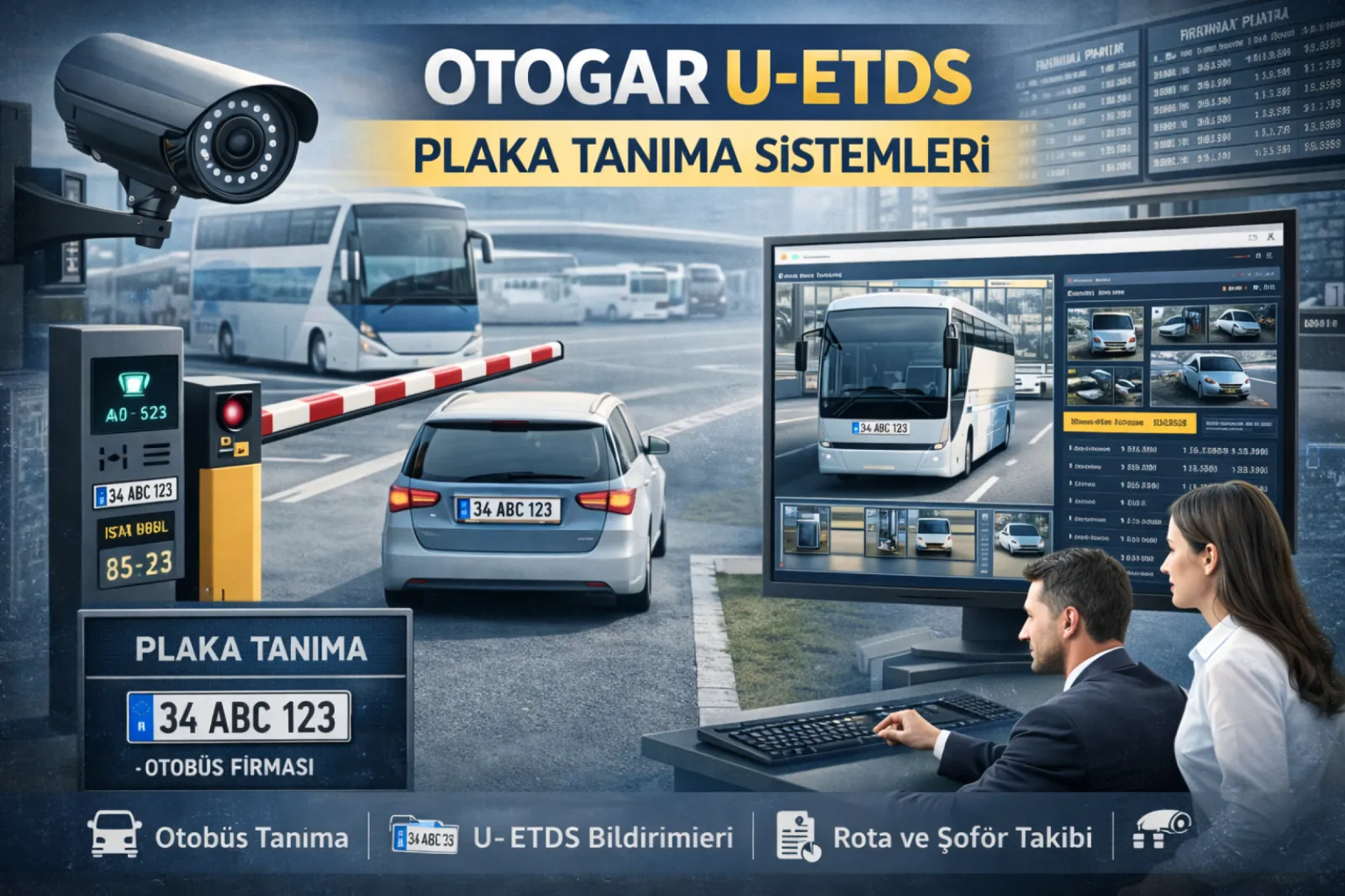
Bus Terminal / U-ETDS
Bus terminals and passenger terminals are critical areas where high vehicle traffic, time sensitivity, and regulatory compliance must be managed simultaneously. In these facilities, it is not enough to simply see vehicle entry and exit; it is also of great importance to know which vehicle entered when, with what authorization or trip information, how quickly terminal records were processed, and how the entire process is reported.
Bus Terminal / U-ETDS Integrated License Plate Recognition System Solutions
Bus terminals and passenger terminals are critical areas where high vehicle traffic, time sensitivity, and regulatory compliance must be managed simultaneously. In these facilities, it is not enough to simply see vehicle entry and exit; it is also of great importance to know which vehicle entered when, with what authorization or trip information, how quickly terminal records were processed, and how the entire process is reported. This is exactly where the U-ETDS integrated license plate recognition system comes into play.
The AOS Bus Terminal / U-ETDS solution is an end-to-end structure aimed at automatically reading vehicle license plates at terminal entry and exit points, digitally recording transition information, supporting data flow in compliance with Ministry processes through appropriate integration infrastructure, and managing terminal operations from a single center. Today, the prominent titles in search intent reflect this need: queries such as “bus terminal license plate recognition system”, “U-ETDS integration”, “terminal entry-exit control”, “waybill control”, and “bus terminal license plate reading system” are clustered together.
What is U-ETDS?
U-ETDS is an electronic system where data determined by the Ministry, belonging to real and legal persons operating under the Road Transport Regulation, is kept and can be shared with relevant public institutions when necessary. Data transmission obligations regarding passenger transport and terminal management are clearly defined on official U-ETDS pages. In scheduled passenger transport, specific information regarding the vehicle plate, personnel, and passengers must be entered into the system before the trip, while in terminal management, the plates and entry-exit times of vehicles entering or leaving the terminal must be transmitted within 24 hours at the latest.
Why is U-ETDS Integration Important for Bus Terminals?
Manual recording methods in bus terminal and terminal management can lead to both loss of time and operational errors. Especially during peak hours, the increase in vehicle entries makes it difficult for the staff on duty to follow multiple transactions at the same time. Thanks to the U-ETDS compatible structure supported by license plate recognition, vehicle information is automatically captured, the transition time is kept in the system, and terminal operation becomes more organized.
In the terminal management and integration documents published by the Ministry, the technical infrastructure for processing terminal entry/exit vehicle plates and time information into the system and performing authorization/document control via the plate is described. This transforms the bus terminal license plate recognition system from just a security tool into a regulatory compliance and digital audit tool. Additionally, it is seen that the obligation to send data to U-ETDS is among the control headings in the audit checklists.
How Does the Bus Terminal License Plate Recognition System Work?
The system works with license plate recognition cameras placed at the entry and exit points of the terminal. When a vehicle approaches the terminal, the license plate image is captured, the license plate data is processed by the software, and a transition record is created. According to the authorized configuration, the system works together with the relevant terminal software and integration services to record license plate, date, time, and event information.
In advanced installations, the solution is not limited to license plate reading. Additional modules such as barrier control, authorization scenarios, black-white list management, bus-platform operations, in-terminal guidance, and central reporting can also be integrated into the system. Thus, not just a single transition point, but the entire terminal movement can be managed digitally.
Waybill and Authorization Control Process
One of the most critical topics in Bus Terminal / U-ETDS solutions is the ability to verify the authorization and movement information of the relevant vehicle via the license plate. In the Ministry's terminal institution integration technical document, the yetkiBelgesiKontrol (authorizationCertificateControl) service method is defined, and it is clearly stated that the vehicle's license plate is sent along with user information in the query. In the same document, it is seen that notification summaries and authorization document lists can also be queried through services. This framework reveals the technical basis of the plate-based digital control approach at the bus terminal entrance.
In this way, the process proceeds in a more controlled manner for the terminal management. In a suitable integration scenario, the system reads the license plate at the vehicle entrance, triggers the relevant verification steps, creates the records based on the terminal operation, and leaves a retrospectively auditable trace. As a result, both speed and record integrity meet in the same structure.
Advantages of Automation in Terminal Entry-Exit Control
Faster vehicle transition
Processes such as manual license plate writing, keeping logbooks, or verbal control are eliminated. Queues decrease during peak entry-exit hours, and the field is managed more fluently.
Lower risk of operational error
The risk of human-induced incorrect license plate writing, time errors, or missing records is minimized. The system automatically processes date, time, and license plate information.
Strong infrastructure for regulatory compliance
The transmission of license plates and entry-exit times to U-ETDS is defined within the official framework for terminal operators. Digital automation contributes to a more organized management of this obligation.
Central monitoring and reporting
Daily vehicle numbers, peak hours, entry-exit records, terminal-based movement summaries, and past event records can be monitored via a single panel.
Security and auditability
Keeping transitions with visual records, license plate data, and timestamps strengthens terminal security and post-event investigation.
In Which Areas is it Used?
Intercity bus terminals
Ideal for the regular recording of vehicle movements in areas with heavy scheduled and non-scheduled passenger transport traffic.
Municipal bus terminals
Provides digital control and reporting in terminal structures operated or supervised by local governments.
Private terminals and transfer centers
Creates controlled vehicle acceptance processes in corporate transportation, shuttle, tourism, and private passenger transport operations.
Integrated paid parking scenarios
License plate recognition and pricing modules can be operated together in short-term or long-term parking areas within the terminal.
Prominent Components of AOS Bus Terminal / U-ETDS Solution
License plate recognition camera infrastructure
High operational efficiency is aimed for with camera positioning suitable for terminal entry-exit, capable of working in different light and field conditions.
Central software management
All transition movements can be monitored from a single screen; user authorizations, reports, and event records are kept in a central structure.
Integration capability
Scenarios compatible with U-ETDS processes, barrier systems, LED guidance screens, parking pricing modules, and local terminal software can be developed.
Recording and archiving
License plate, date, time, camera image, and event information can be stored regularly for retrospective review.
Why AOS?
AOS offers a solution approach that carries its field experience in parking and license plate recognition to terminal operations, focusing not only on camera installation but also on software, integration, field flow, and management screens together. The main goal in Bus Terminal / U-ETDS projects is not just to see the vehicle, but to make sense of the transition, verify the record, and manage the operation sustainably.
Therefore, our solution approach is built on these four foundations: correct field discovery, correct hardware selection, correct integration setup, and correct reporting infrastructure. The result is a system that accelerates terminal management, increases record quality, and strengthens corporate control.
The Bus Terminal / U-ETDS integrated license plate recognition system is no longer just a technology investment in today's terminal management; it is a strategic need in terms of operational speed, digital record order, regulatory compliance, and corporate audit capacity. Systems that can automatically read the license plate of the vehicle entering the terminal, record the transition time, support verification processes with a suitable integration structure, and report all movements centrally are one of the fundamental building blocks of modern bus terminal management.
The Bus Terminal / U-ETDS solution we offer as AOS provides a fast, controlled, and scalable digital management infrastructure for intercity passenger terminals, municipal bus terminals, and terminal areas with heavy vehicle movement.
Related Products
Related References
For Detailed Info and Presentation
Our expert and technical team will contact you to prepare a detailed feasibility study.